


There is an art to arrival. For a select few, transit is not merely a means of moving between points on a map. It is an extension of personal sanctuary, a deliberate transition into stillness.
In recent years, Goa’s appeal has moved beyond its storied palm-fringed coastlines and heritage Latin quarters, to becoming a preferred sanctuary for UHNWIs seeking sanctuary in private, design-forward estates.
Yet, bringing a Bombardier Global 7500, a Gulfstream G650ER, or an AgustaWestland AW139 into a tropical coastal enclave requires more than just setting a flight plan. It demands a sophisticated understanding of general aviation infrastructure, microclimate preservation, and regulatory navigation.
Whether arriving by private jet at one of Goa’s airports and continuing by road or helicopter to a private estate, here is all the key information on managing your private aircraft in Goa.
The Evolution of General Aviation in India’s Coastal Riviera
Historically, private aviation in Goa was bound by the operational rhythms of a shared military airfield. Private jets competed for tight landing slots amidst naval exercises, often restricted to tight operational windows.
Today, the landscape has fundamentally shifted. The opening of Manohar International Airport at Mopa has added a modern civilian airport to Goa’s aviation network, while helicopter operations to private landing sites remain possible subject to applicable approvals, site requirements and operational coordination.
Within easy private-aviation reach of Mumbai and Bengaluru, Goa can also serve as an international arrival point for suitably cleared foreign-registered business aircraft.
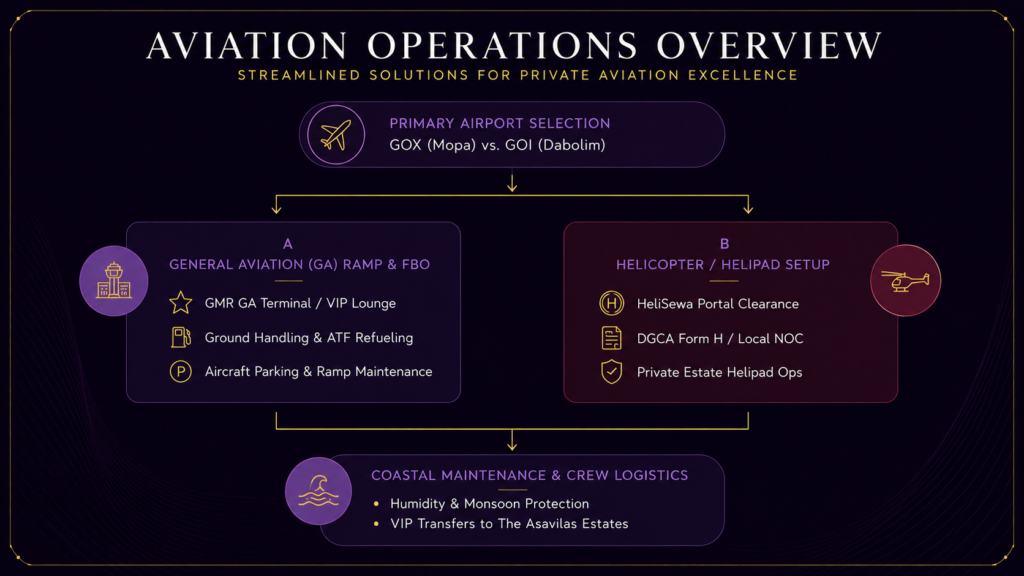
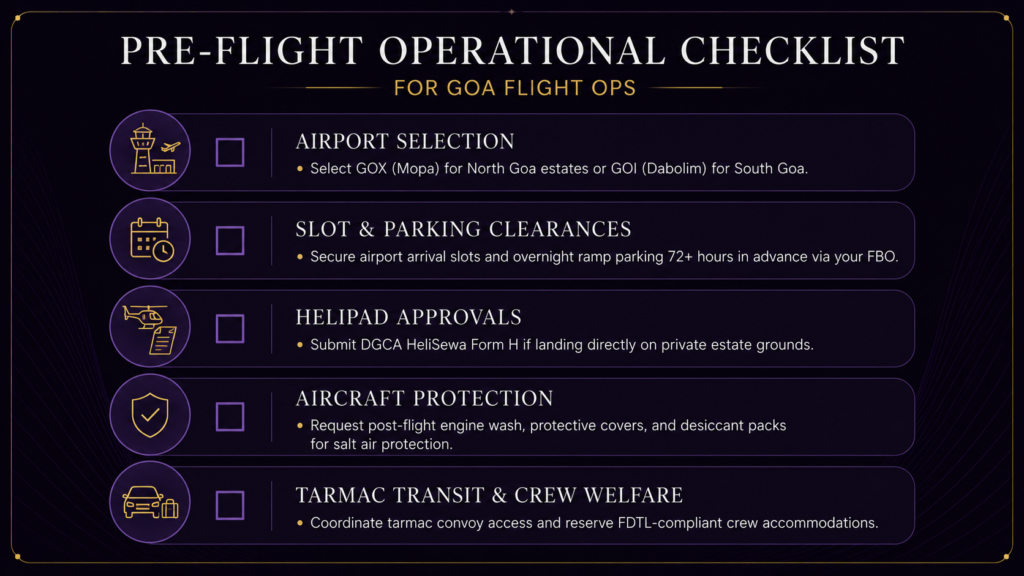
Airport Selection: Manohar International Airport (GOX) vs. Dabolim Airport (GOI)
Choosing where to touch down in Goa depends entirely on your final destination and operational requirements. The state operates on a dual-airport framework, each serving distinct geographical regions and offering different ground capabilities.

Manohar International Airport, Mopa (GOX / VOGA) — The Modern GA Capital
Located in the rolling hills of Pernem in North Goa, Manohar International Airport (GOX) is the crown jewel of Goa’s civilian aviation infrastructure. Operated by GMR Goa International Airport Limited, GOX was designed from the ground up to accommodate modern long-range business jets.
- Infrastructure: A 3,750-metre Runway (10/28) at a Code 4E aerodrome, suitable for a wide range of large business and commercial aircraft.
- General Aviation & Handling: Mopa features dedicated general-aviation parking and infrastructure. Non-scheduled and GA flights are managed seamlessly through authorized Ground Handling Agencies (GHAs) and airport-approved VIP handling teams operating under advance slot approvals.
- Operating Hours: Mopa offers H24 air-traffic, fuelling and handling services, with GA and non-scheduled operations managed through advance airport slot coordination. While domestic GA movements can typically be coordinated within 24 hours, foreign-registered aircraft (N-reg, M-reg, etc.) require a DGCA flight clearance (YA authorization), which typically takes 3 to 7 working days to process.
- Proximity: Generally, the more convenient airport for North Goa destinations such as Assagao, Siolim, Anjuna and Mandrem.
Dabolim Airport (GOI / VOGO) — Naval Enclave Logistics & South Goa Proximity
Situated along the central coast in Mormugao, Dabolim Airport (GOI) operates within the Indian Navy enclave of INS Hansa. While historically the sole entry point, it now primarily serves those heading to South Goa’s sprawling beachfront sanctuaries.
- Infrastructure: A 3,430-meter Runway (08/26). While capable of accommodating heavy jets, ramp space is closely regulated.
- Operational Constraints: Dabolim remains a joint civil-military operating environment. GA and non-scheduled movements can be accommodated, including during certain military-flying periods with prior ATC permission, but operators must plan around published military, traffic, runway-maintenance and parking restrictions.
- Parking Limits: Long-halt and overnight parking at Dabolim should be arranged in advance.
Side-by-Side Comparison Matrix for Private Jet Operators
| Operational Variable | Manohar International Airport, Mopa (GOX / VOGA) | Dabolim Airport (GOI / VOGO) |
|---|---|---|
| Primary Region Served | North Goa (Assagao, Siolim, Pernem, Mandrem) | South Goa (Mormugao, Salcete, Cavelossim) |
| GA Ramp & Parking Space | Airport apron / authorised stands; GA subject to airport approval | Shared, limited GA bays; naval priority |
| FBO Facilities | GA/non-scheduled handling subject to airport-approved arrangements | Ground handling through authorised airport handlers” |
| Customs & Immigration | Customs & immigration available H24; private/non-scheduled processing subject to airport procedures | Handled via VIP lounge protocol |
| Drive Time to North Goa Estates | ~25–35 minutes via NH-66 | ~60–75 minutes |
On-the-Ground Logistics: FBOs, Ramp Handling & Jet Servicing
When landing a multi-million-dollar airframe on a tropical ramp, the quality of ground handling is non-negotiable.
Fueling, Ground Support, and Cabin Reprovisioning
- Jet A-1 Fuel Supply: Mopa provides Jet A-1 through BPCL, with both hydrant and bowser fuelling facilities.
- Ground Support Equipment (GSE): Fully equipped ramps offer 28V DC and 115V 400Hz Ground Power Units (GPU), high-capacity Air Conditioning Units (ACU) essential for pre-cooling cabins in tropical heat, and Air Start Units (ASU).
- Cabin Services: Full potable water replenishment, lavatory servicing, and luxury inflight catering partnerships with Goa’s top dining establishments can be arranged directly through your FBO concierge.
Foreign-Registered Jets: Clearances & Overflight Permits
For aircraft registered outside India (N-registered, M-registered, 2-registered, etc.), entering Indian airspace requires strict adherence to Directorate General of Civil Aviation (DGCA) protocols under CAR Section 3.
Foreign-registered non-scheduled flights must obtain a DGCA YA (Yield Approval) flight clearance code prior to entering Indian airspace. Operators should plan for a lead time of 3 to 7 working days for standard YA approvals, and up to 7 to 14 working days if crew or passengers hold passports from Prior Reference Countries (PRC). Flights must also satisfy Indian customs, H24 immigration, security clearance, and local aerodrome slot allocations prior to departure.
Helicopter Logistics: Direct Helipad Access to Private Villas & Estates
For those who view highways as entirely optional, helicopter transfers represent the ultimate synthesis of speed and discretion. A flight from the tarmac at GOX or GOI reduces travel time to a mere 10-minute aerial jump over Goa’s lush coastal canopy.
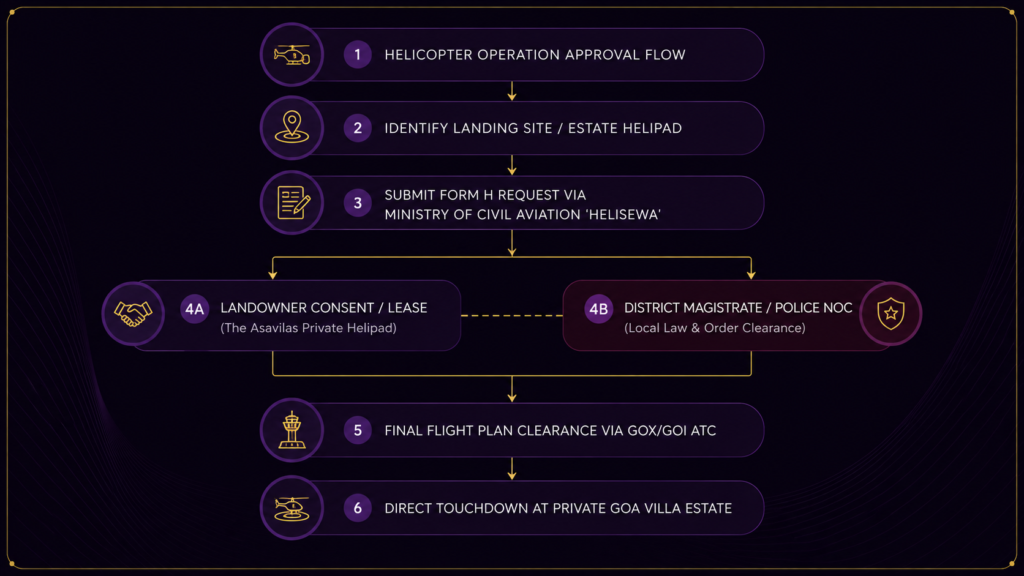
While transfers to DGCA-approved commercial and resort helipads (such as those at Fort Aguada or Panaji) operate seamlessly, landing directly on a private villa or estate pad requires prior compliance under DGCA CAR Section 4 (Series B). Off-field temporary landing permissions must be coordinated in advance through aviation handlers to secure No Objection Certificates (NOCs) from the District Magistrate, local police, fire services, and the local Village Panchayat.
The Regulatory Framework: DGCA CAR Series F Part II & HeliSewa
Helicopter operations to private landing sites are subject to the applicable DGCA requirements for the type of landing area and operation, together with HeliSewa and other applicable local/airport coordination.
- The HeliSewa Portal: The Ministry of Civil Aviation’s HeliSewa digital platform has streamlined landing approvals on non-licensed, private landing sites across India.
- Form H Submissions: Your flight operator submits a “Form H” intimation for applicable landing-area operations, including details of the proposed landing site and operations.
- Local Approvals & NOCs: For a private landing site, the operator must obtain the property owner’s consent and submit the required HeliSewa/Form H information. The proposed operation is communicated to the relevant District Collector/Magistrate through HeliSewa. Additional permissions or restrictions may apply depending on the site, local regulations, security circumstances and nature of the operation.
An important note: DGCA has separate requirements for: Temporary helicopter landing areas — CAR Section 4, Series B, Part II; Regular-use helicopter landing areas — CAR Section 4, Series B, Part V; and Licensed heliports — separate heliport requirements.
Private Estate Helipad Design Considerations
For owners building or customizing an estate in Goa, incorporating an off-airport landing zone requires early architectural planning.
The landing area must be designed around the helicopter type and intended operation, with appropriate TLOF/FATO dimensions, load-bearing capacity, safety area, obstacle clearance, approach/departure surfaces, markings and emergency provisions.
Maintaining Airworthiness in a Coastal Climate: Corrosion, Humidity & Monsoons
Goa’s tropical coastal setting provides a breathtaking backdrop, but salt air, high humidity, and heavy seasonal monsoons demand proactive care for sophisticated aircraft.
Salt Air & Galvanic Corrosion Protection
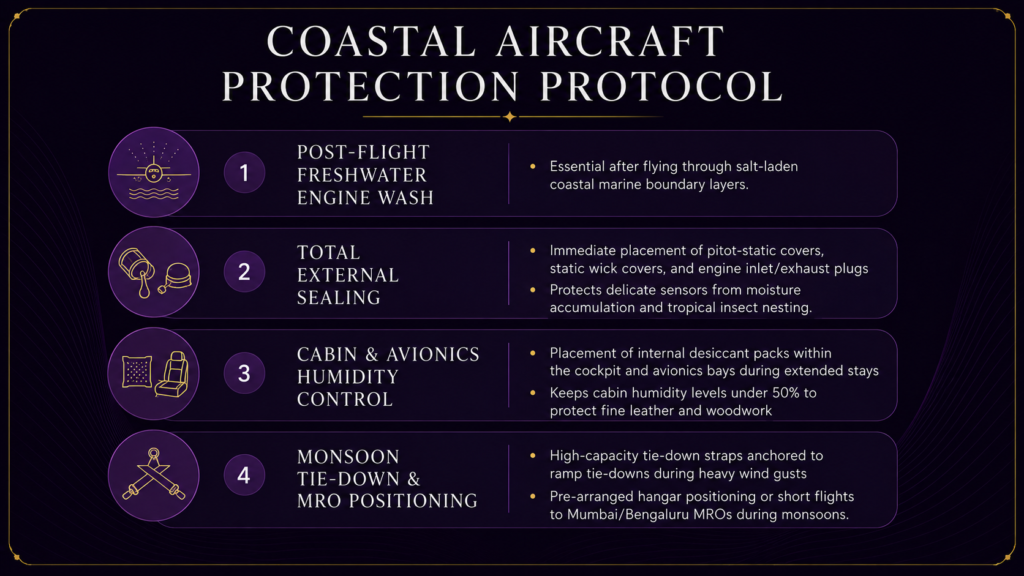
The marine boundary layer along the Arabian Sea carries fine salt particles that can accelerate corrosion on exposed airframe components, landing gear assemblies, and turbine blades.
Aircraft operating regularly in Goa’s humid, salt-air environment should follow the manufacturer’s corrosion-control, inspection and preservation procedures, with particular attention to exposed components and engine/APU areas.
Monsoon Protocols (June to September)
During the southwest monsoon, heavy rain and sudden wind gusts require additional ramp precautions:
- Tie-Down & Gust Locks: Ensure heavy-duty tie-down straps are anchored to approved ramp points, and internal flight control gust locks are engaged.
- Hangar Storage Options: While open ramp parking is common during dry months, long-term stays during the monsoon are best managed by securing hangar space at GOX or arranging short positioning flights to major maintenance facilities in Mumbai (BOM), Hyderabad (HYD), or Bengaluru (BLR).
- AOG Emergency Services: In the event of an Aircraft On Ground (AOG) situation, depending on the aircraft type and fault, specialist engineering support and parts may need to be mobilised from another Indian maintenance base.
Ground Seamlessness: VIP Transit & Crew Layover Architecture
A private flight is only as good as its final leg. Ensuring smooth transit for the owner, along with proper rest for the flight crew, completes the operational picture.
Armored & Ultra-Luxury Chauffeur Logistics
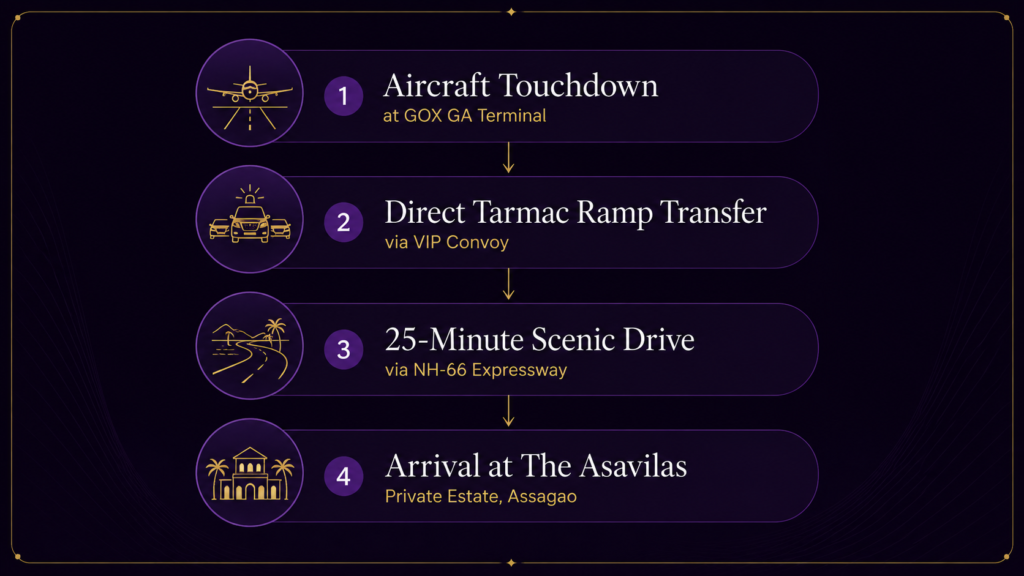
Upon landing at the GOX General Aviation Terminal, private tarmac transfers bypass main passenger terminals entirely. Armored or luxury SUVs (such as the Mercedes-Maybach GLS, Range Rover Autobiography, or Toyota Vellfire) can be pre-cleared for direct ramp access, allowing seamless movement from jet stairs directly to your convoy.
Crew Welfare & Duty Time (DGCA FDTL Compliance)
Your flight crew’s rest environment is essential for safety and regulatory compliance under DGCA Flight Duty Time Limitations (FDTL). Ensuring your pilots and flight attendants have high-end accommodations ensures smooth, delay-free departures.
- North Goa Crew Rest Options: For flights landing at GOX, high-end boutique hotels or luxury villas in Assagao, Siolim, and Mandrem offer quiet, serene environments just 20 minutes from the airport.
- South Goa Crew Rest Options: For flights using GOI, 5-star beachfront resorts in Cavelossim and Utorda offer full amenities and short airport commute times.
Operational Cost Expectations in Goa
Managing a private aircraft requires transparent financial planning. Actual costs depend on airport, aircraft MTOW, domestic/international status, parking duration, handling provider, fuel uplift, passenger/crew requirements and any special services. Operators should obtain a current quote from the airport/authorised handler before scheduling the flight.
The Asavilas: Elevating Estate Living with Private Aviation Integration
At The Asavilas, we recognize that an exceptional home should simplify every aspect of your lifestyle. As developers of ultra-luxury estates in Goa’s most desirable locations—including Assagao, Moira, and the pristine hinterlands of North Goa—we design properties that cater directly to global travelers.
From master-planned estate layouts designed for private helicopter landings to dedicated concierge teams that work hand-in-hand with your family office, our homes offer total privacy, architectural distinction, and effortless access.
By pairing world-class aviation logistics with thoughtfully designed residential architecture, arriving at your home in Goa becomes as effortless as the stay itself.
Explore the portfolio of private estates at The Asavilas and discover a new standard of luxury living in India’s coastal paradise.